

Watch Webinar: Attract More Patients: Marketing a Medical Practice Ethically and Effectively
Attract More Patients:
Marketing a Medical Practice Ethically and Effectively
This webinar is presented by me, Elle, a growth marketing consultant and the founder of health marketing consultancy, Brand Shop. We work primarily with health technology companies, medical practices (both individual and group), and health brands to help them grow.
Before founding Brand Shop, I led patient recruitment into clinical trials for some of Australia’s largest universities and CROs. I also led marketing at MedicalDirector and HealthShare, so I’ve seen this space from many sides—clinical, technological, and marketing.

Below, we’ll cover:
Today we’re diving deep into strategies for ethical and effective medical marketing. Specifically, you’ll learn how to:
- Leverage digital marketing to attract more patients
- Prioritise patient acquisition for preferred procedures
- Build strong referral networks with other providers
- Patient acquisition sources
- Digital advertising do’s and don’ts – Google, Facebook, SEO and more
- Referral pathways and outreach
- Optimising the patient funnel
- Navigating Australia’s medicolegal landscape
Why Marketing Matters in Healthcare:
Let’s acknowledge something important first: Today’s medical practitioners have opportunities to grow their practices in ways previous generations simply didn’t. And there are a slew of Australian practices doing it incredibly well.
Let’s look at a few examples on Instagram:
- Monash IVF: 12.5K followers
- Dr. Andrew Harken (Osteo): 375K
- Dr. Preeya Alexander (GP): 95K
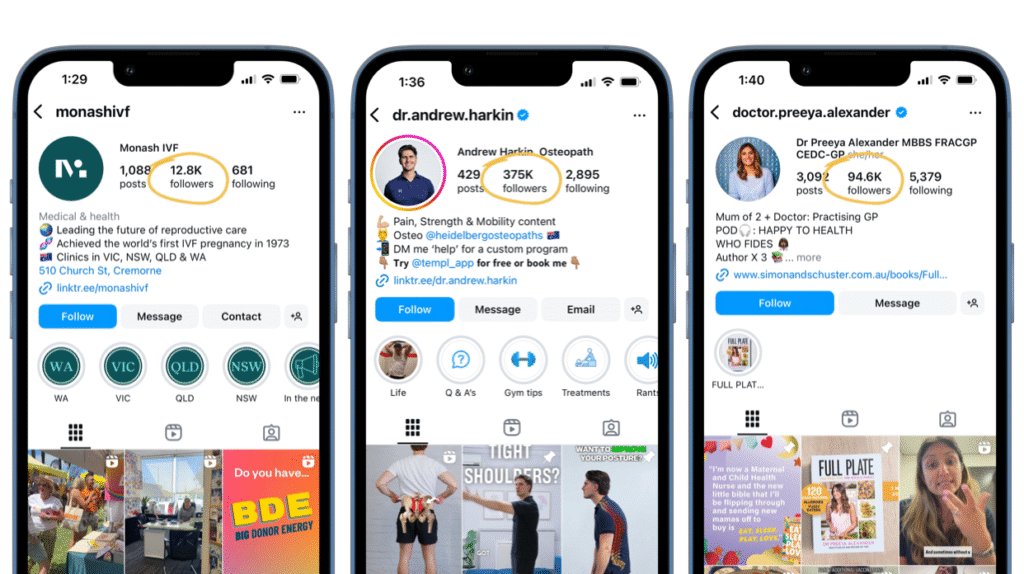
And it’s not just about being “popular” online. These accounts are clear, professional, and strategic. They have “Book Now” buttons, email signups, and regular content that builds trust and visibility, and perhaps most importantly – a steady stream of new patients.
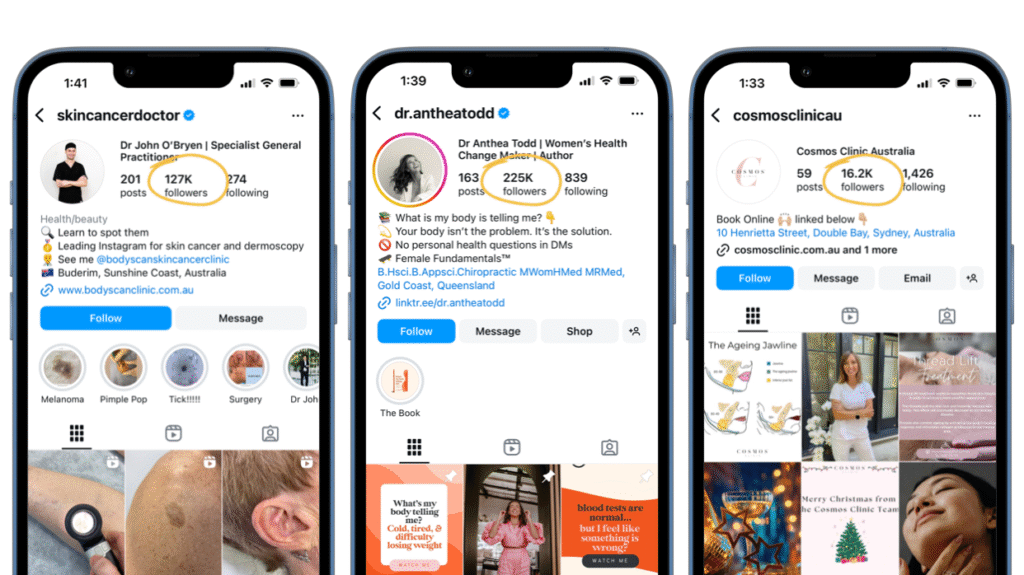
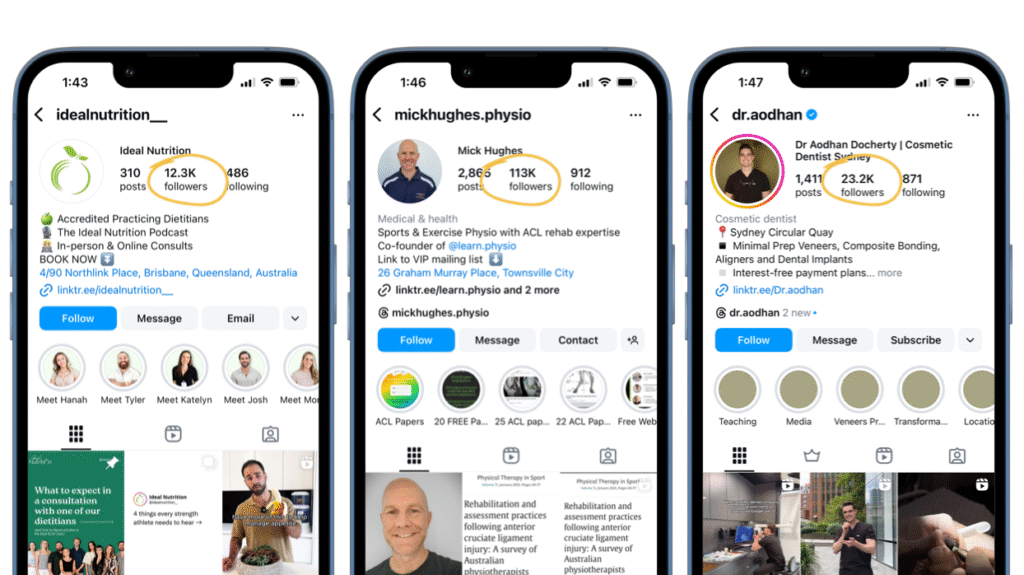
A few more:
- Dr. John O’Bryen (GP, skin cancer): 127K
- Dr. Anthea Todd (Chiro): 225K
- Cosmos Clinic (Cosmetic Practice): 16.4K
- Ideal Nutrition: 12.4K
- Mark Hughes (Physio): 113K
- Dr. Aodhan Docherty: 23K
Each of these practitioners has used content, credibility, and consistency to grow a direct relationship with potential patients.
The Patient Funnel:
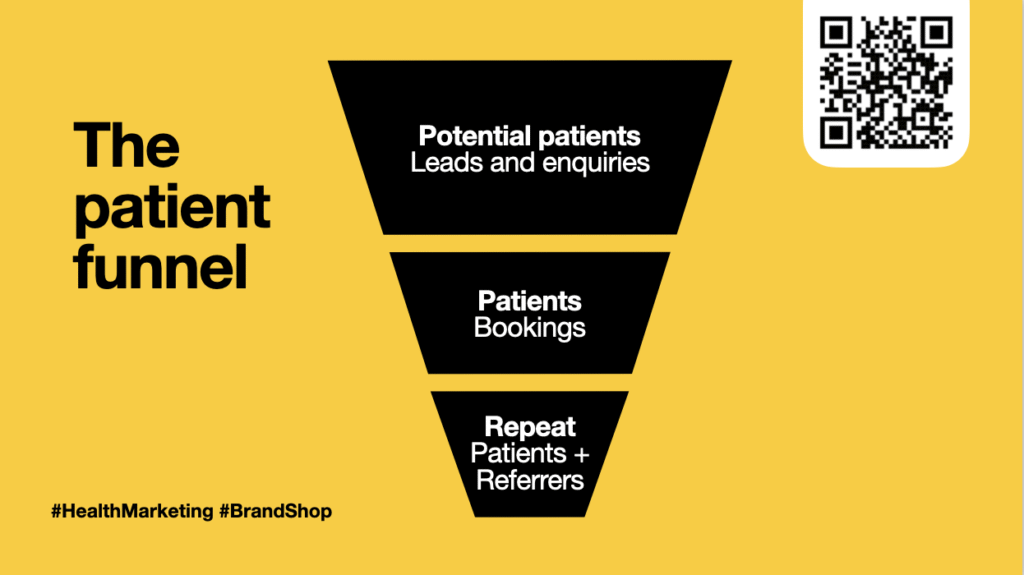
I’m sure you know this from your own practices that in health, just as in other businesses, we’re dealing with a funnel of the potential patients that engage with us. That is leads and enquiries. Some of those become patient bookings and in turn, some of those become repeat patients and referrers.
At the top: awareness—people discovering you.
Then: consideration—do they trust you? Are you the right fit?
Then: conversion—do they actually book?
And finally: retention and advocacy—do they come back or refer others?
Each step is critical.
Patient Acquisition Sources
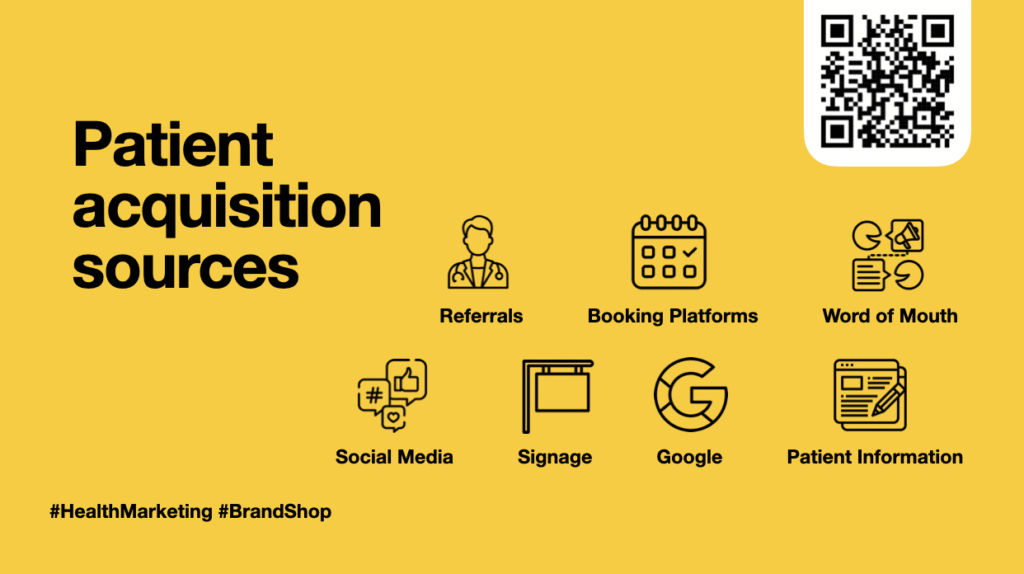
Let’s look now at some common ways practices attract new patients—and where there’s room to grow.
Some of these you’ll be doing already really well, some of them you may not have explored at all and others you may be doing but have opportunities to improve. We’ll take a look at practical ways to get new patients or new potential patients into the top of that patient funnel and hopefully show you a thing or two that you haven’t seen before.
Booking Platforms
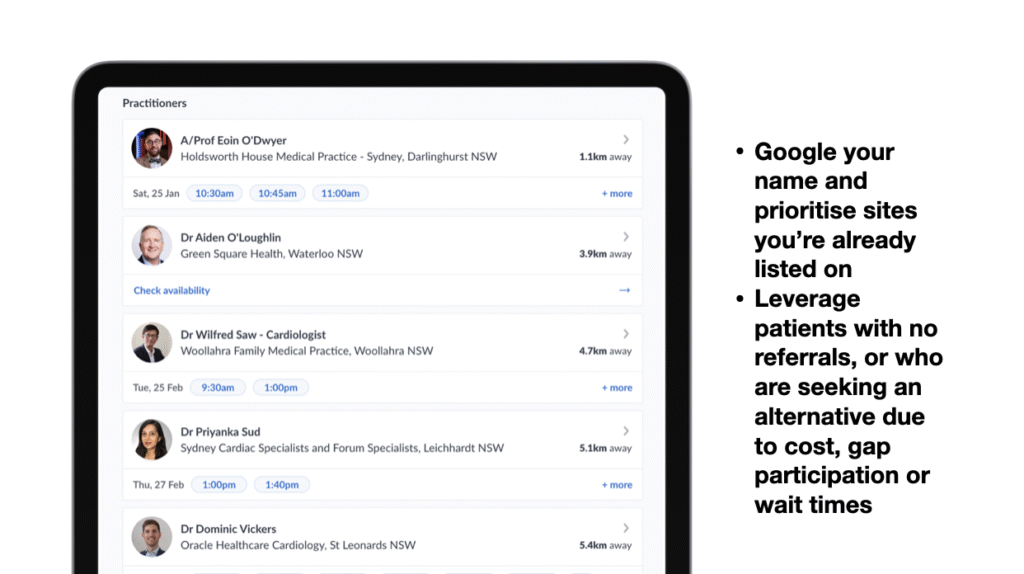
Third-party websites like HealthShare, HotDoc, or MyHealth1st are often the first result patients see when they Google you. Let’s start with booking platforms. These are the third party websites that patients can explore to find out information about you or your practice and either get your contact details or make bookings with you directly.
One easy way to get in front of new potential patients here is to create and claim profiles on these popular third party booking sites. Once we’ve done that, we want to be optimising the profile with subspecialties, bios, qualifications, hospital affiliations, languages spoken, and any other information that will help a potential patient decide whether you are the right fit for them. And then thinking back to that funnel, we want to be including booking and website links and phone numbers where possible so that it’s easy for potential new patients to reach out, make inquiries and book with you where it’s appropriate.
So how do you know which third party booking sites are listing details for your practitioners or for your practice? First step is to Google your name and prioritise the sites that you are already listed on. That way if patients are landing on these sites instead of your own website, you can be sure that the information there is accurate and up to date and that they’ve got links to be able to book with you or make inquiries where necessary.
Now, why would we even bother with these third party booking platforms or websites? Um, and it’s a great question, we get it all the time. What’s really interesting about this is that patients will often turn to Google to either find a suitable practitioner if one hasn’t been recommended for them or to find the contact details of one who has been recommended for them. And in a lot of cases, these third party booking sites are showing up in Google just as often as your own websites. And so if we have a patient here looking for example for Associate Professor UNO Dwyer, we want to make sure that if they’re clicking through to his profile that they can see the information necessary to make a booking or to assess his suitability for their care.
Another interesting patient pathway here is that sometimes patients will be given a referral for a specialist or for a practitioner who isn’t suitable for them, and this might be because of wait times, fees or fee structure, or maybe that practitioner doesn’t participate with their health fund. In those instances, patients are actively searching for alternate practitioners. And this is also the case when patients have an open referral or referral which isn’t named. And so in these scenarios it’s actually really beneficial to have your practitioners and your practice listed on these websites so that if a patient has good cause not to see a practitioner that they have been referred to, your details will be there for them to consider instead.
Your action items here:
- Claim your profile
- Update it with a bio, qualifications, languages, fees, and affiliations
- Include booking/contact links
And if you’re wondering “Why bother?”, the reality is:
Even if you have a great website, third-party platforms often outrank you on Google.
So if a patient Googles “Dr Jane Smith Endocrinologist Sydney,” and HealthShare pops up first, we want to make sure that listing is accurate, professional, and actionable.
These platforms also help in two key scenarios:
- When patients are given a referral but can’t access that practitioner due to wait times or cost.
- When patients receive open referrals and are actively choosing a specialist.
Word of Mouth
Word of mouth, most frequently, comes from happy, satisfied patients. Here are some areas to think about to grow word of mouth referrals in your practice:
- Provide an exceptional patient experience
- Optimise and improve interactions during all patient touch points: pre-booking (website + enquiries), booking (appointment process, confirmations, reminders), clinical experience (consults + procedures), post-appointment (front desk, payments, rebooking, during recovery, etc)
- Measure and analyse patient satisfaction
Referrals: Traditional & Scalable
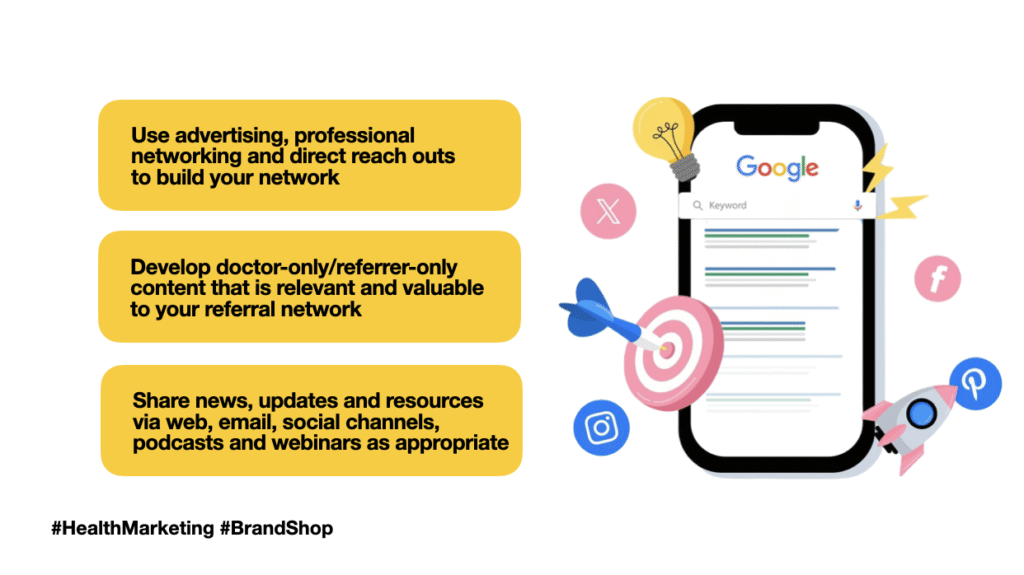
Okay, let’s move on to referrals. I’m sure I don’t have to tell you why we need them. Care is often multifaceted. And so one very logical way to build your practice is to build a network of potential healthcare professional referrers. And these might include GPs, allied health practitioners or other related health services where appropriate. Once we have a network of potential referrers, we want to make sure that we’re remaining top of mind so that they actually remember to refer us when they have patients who might be suitable for our care.
One way to do this is to provide valuable referrer-only content. We don’t want to be spamming our referrer network, but instead providing medical and health information which benefits patient care. And so we’ll need a strategy and a plan to be able to do this really effectively. And the third thing we want to be doing is sharing software friendly referral templates and address book contact cards so that referrals are logistically easy when an appropriate patient does pop up.
Now, I know a lot of you’ll be used for the more traditional methods of building a referral network and those are still very effective when it comes to joining conferences, CPD programs or professional events, but we can now also use digital channels to build a referral network. Scalably, we can do this with advertising, which is paid but will give us an immediate reach into new potential referrals. And we can also do this by reaching out directly digitally to build our network. As I mentioned before, we then want to have a strategy for developing doctor-only or referral-only content that’s relevant and valuable to our referral network.
And so if you’re thinking about building a scalable referral network, whether you’re a specialist working independently or a group practice with many GPs or allied health professionals, the key is to approach it as a long-term relationship. Referrals don’t come from one-time contacts. They come from consistent engagement, clear communication, and demonstrating value over time.
Referrals are still the single biggest driver of patients in many specialties. That’s why we want to build strong professional networks with:
- GPs
- Allied health practitioners
- Other specialists (if appropriate)
There are three key strategies here:
- Stay top of mind – Regularly check in with your network.
- Provide valuable, referrer-only content – Don’t just say “send us patients.” Instead, provide clinical updates, diagnostic tips, or shared care protocols that help them in practice.
- Make the referral process logistically easy – Share pre-filled templates or software-friendly e-referral formats.
We can build this network both in-person (through CPD events, hospital meetings, and conferences) and digitally—through targeted outreach and ads.
Digital Presence & Your Website
Your website is your practice’s digital front door. It’s the first thing that patients—or even referrers—will look at when deciding whether to work with you or book an appointment. The role of your website is to not only provide the right information, but also to convert browsers into patients. That means having clear and accessible booking links, relevant practitioner bios, FAQs that reflect real patient concerns, and of course, ensuring it’s optimised for mobile—since more than half of your traffic will likely come from a mobile device.
Something often overlooked: your website should speak to both patients and other healthcare providers. A simple way to do this is to have a dedicated referrers section on your site that explains how and when to refer, what your approach to care is, and what to expect from shared management. It helps set you apart and reinforces clinical trust.
It’s where people go to:
- Learn about your services
- Decide whether you’re the right fit
- And most importantly—book
Your site should:
- Be mobile-optimised
- Feature up-to-date bios
- Have clear calls-to-action (“Book Now” or “Refer a Patient”)
- Include a section for referrers with:
- How to refer
- Clinical focus areas
- What to expect post-referral
Many practitioners lose patients at this stage because there’s too much friction—unclear info, no online bookings, or outdated credentials.
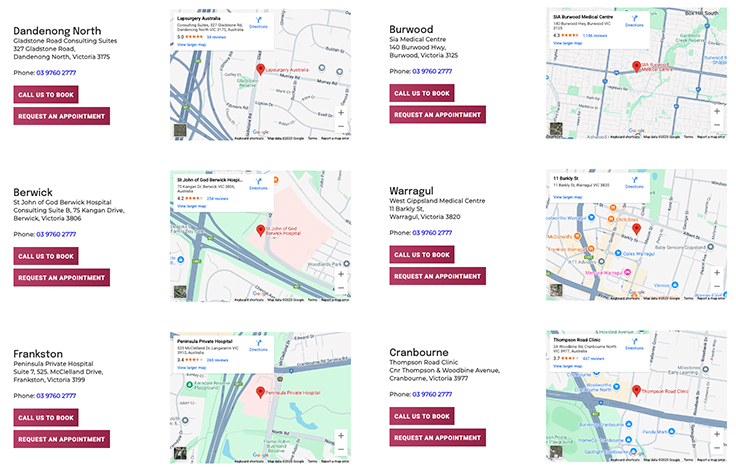
Here’s an example showing ‘Book now’ buttons everywhere it’s relevant:
Google Maps and Business Listings
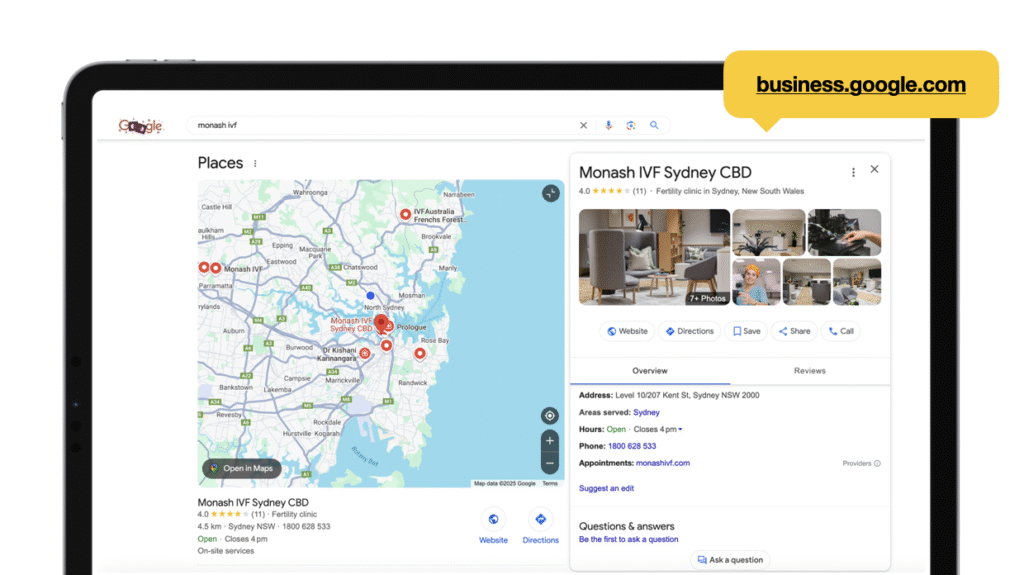
The best way to start here is to Google your name, and clinic name, and you should see a panel like this come up on the right. These are Google business listings, and they’re connected to Google Maps. In many cases they sit above Google search (SEO) results, so you’ll show up if people are looking for a cardiologist, or GP or Nutritionist etc locally.
You can get started with a Google Business listing at business.google.com and you’ll be able to add things like your practice address, opening hours, phone number, website links and phone numbers. People can also call directly from your contact card here, which is great if they’re using mobile.
(Hint: this doesn’t have to break the bank)
Optimising the Patient Funnel
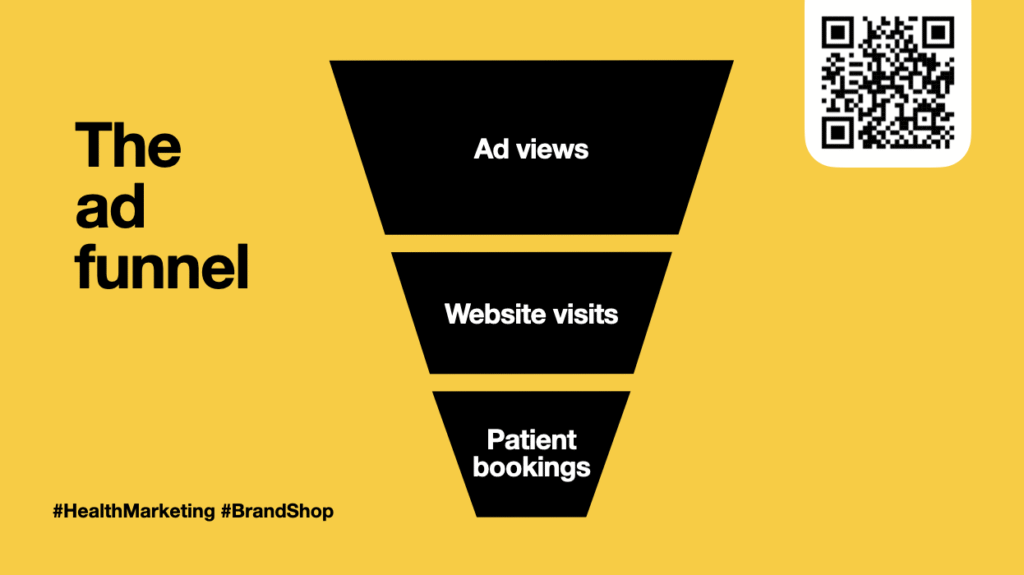
This is the journey a patient goes through from the moment they first discover you—maybe through a booking site or from a referrer—all the way to making a booking and becoming a regular patient.
For many practices, there are leaks in this funnel. That is, people are finding you, but not booking. Or they’re booking once, but not returning. And there are lots of reasons this can happen—maybe there’s not enough information online, maybe they don’t know if you’re taking new patients, or maybe they don’t feel like you’re the right fit for their particular concern.
So your job as a practitioner or a practice manager is to plug the gaps in that funnel. Make sure that once someone finds you, they understand exactly what you do, how to book with you, what to expect when they arrive, and how they’ll be cared for.
This might be through your website, social media, automated appointment reminders, patient onboarding packs, or even a well-structured intake form that asks the right questions to tailor the patient experience.
This is the journey a patient takes from first discovery to long-term loyalty. Common funnel leaks include:
- No clear next steps (“How do I book?”)
- Confusing pricing or availability
- Lack of trust or personal connection
- Poor follow-up (no reminders, no thank-yous, no review requests)
You can plug these gaps with:
- Better intake forms
- Onboarding messages
- Follow-up care instructions
- Referral request templates for patients to give their GPs
Every small improvement here increases conversion.
Google, Social Media and Digital Advertising
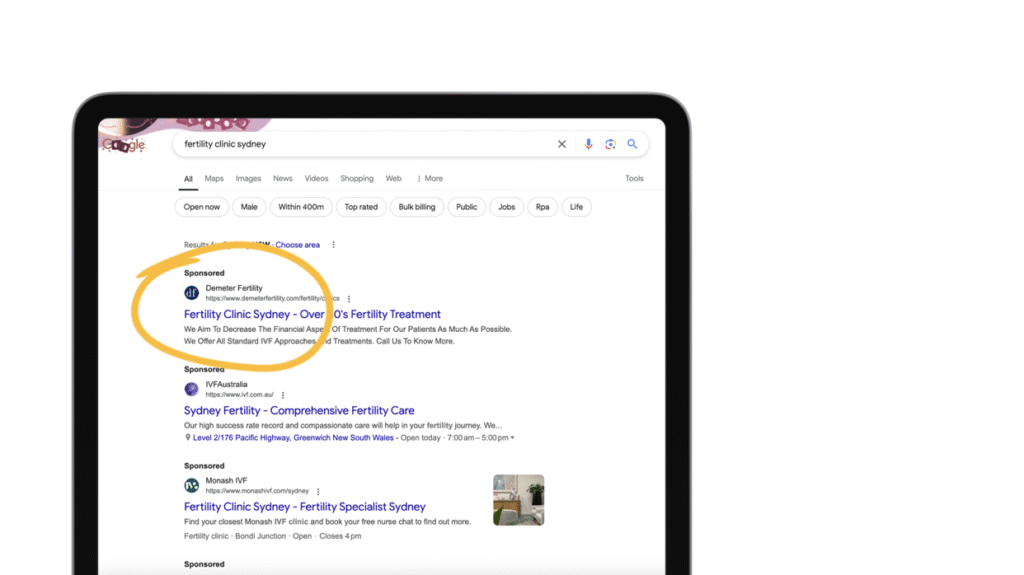
There’s often a perception that medical advertising is either prohibited or ineffective. Neither is entirely true. What’s important is that any advertising complies with AHPRA’s advertising guidelines, is not misleading, and doesn’t promote unnecessary interventions. But within those bounds, there are a lot of effective strategies.
For example, promoting your availability for particular procedures, highlighting new services, or even amplifying content like blog posts or patient FAQs can drive meaningful engagement. Platforms like Google Ads and Meta (Facebook/Instagram) can be highly targeted, allowing you to focus on specific conditions, patient demographics, or even local geography.
But here’s the key: advertising works best when it fits into a broader strategy. It shouldn’t be your first step, it should be one of your last. It supports an already strong patient acquisition funnel—it doesn’t replace one.
Google, Facebook, Instagram and so on have their own health advertising standards:
Health advertisers must not:
- Must not make people feel bad about themselves — we are prohibited from running campaigns that imply or attempt to generate negative self-perception
- Must not assert or imply personal attributes — we are prohibited from running campaigns that share, ask or reference personal attributes of the viewer
- Must not promote speculative or experimental therapies or medical treatments
- Must not include references to prohibited or controlled substances
The Google and social media platforms will ban your content if it does not comply with these standards.
Now, when you’re deciding what information to include in your advertising campaigns, it’s crucial to remember that in Australia, all health advertising is regulated by the National Law, AHPRA, and your professional board. That means you cannot use testimonials, you must avoid misleading or deceptive claims, and you should not promote unrealistic expectations. If you’re unsure about your advertising or website content, AHPRA offers detailed guidance and examples (and so do we)—and it’s always better to get clarity early before you go live.
We’ll explain some of the restrictions in more detail in the next section, but you can:
- Promote new appointment availability
- Highlight services like telehealth, specific procedures, or areas of interest
- Share blog posts, patient guides, or community health initiatives, as long as they are education-focused
Paid ads (on Google or Meta) should be the last thing you invest in, once your foundations are solid. Otherwise, you’re just paying to send people to a funnel with holes in it.
AHPRA Compliance & Ethical Marketing
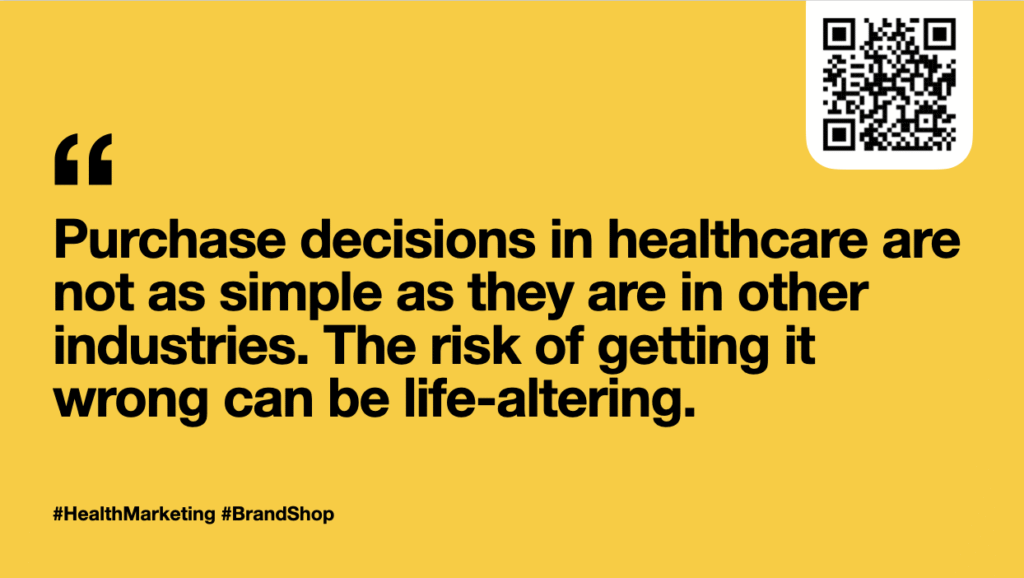
Purchase decisions in healthcare are not as simple as they are in other industries. Choices in healthcare carry a far greater emotional investment than other industries, and there is far more at stake for patients if they make the wrong choice. Health choices, by their very nature, can be life-altering.
Australia has some of the strictest healthcare marketing laws in the world. That’s a good thing—it protects patients and keeps the system trustworthy.
The purpose of the Australia’s health communications guidelines are to protect public interest and Ensure that patients receive accurate, clear information about regulated health services. And that the healthcare choices of the public are not compromised.
So put really simply, what’s appropriate in other industries is often not appropriate in ours.
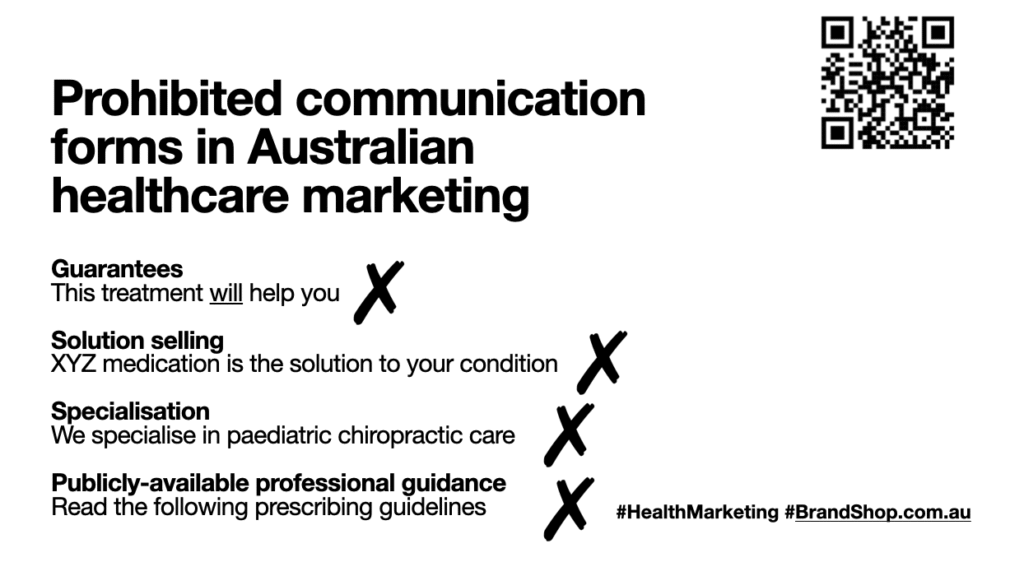
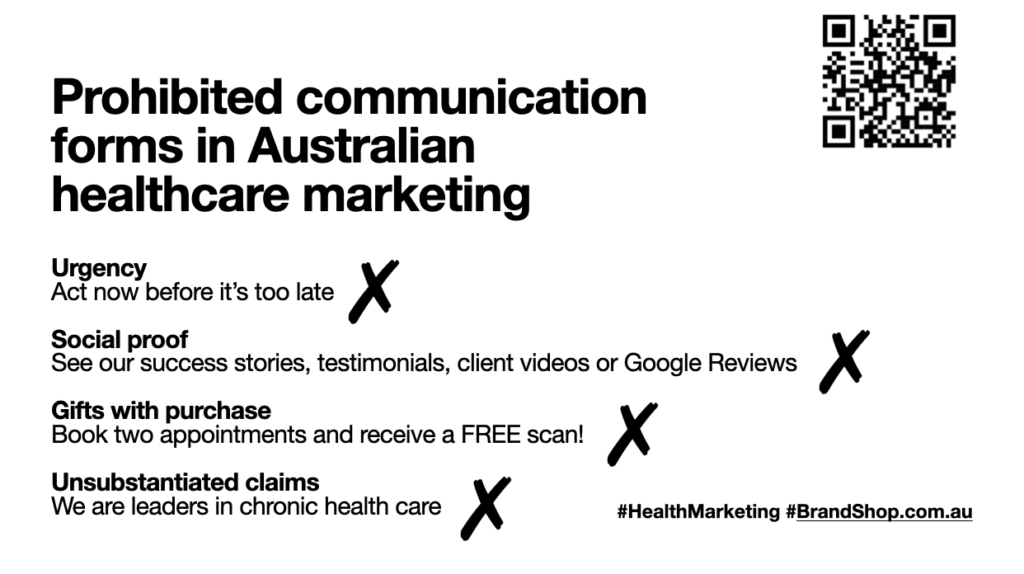
That said, it’s still 100% legal—and often incredibly effective—to market ethically, clearly, and responsibly. Below are the key AHPRA no-gos.
In health communications, we must not be false, misleading or deceptive
Avoid:
- Using exaggerated language, or oversimplifying or omitting important details
- Minimising or underplaying potential risks
- Making claims about potential results or cures
- Making claims that a health service is superior
- Referencing scientific information that is not easily understood, or without sufficient evidence
- Making comparisons between health practitioners, professions or outcomes without complete information
- Referring to Medicare-subsidised services as ‘free’
In health communications, we must not encourage the unnecessary use of health services
- Encouraging patients to buy or use a health service that they do not need and is not clinically indicated or provides no therapeutic benefit
- Encouraging patients to attend regular, periodic or future appointments where there is no clinical indication to do so
- Recommending appointments for the prevention of disease, without clinical or therapeutic need
- Creating an impression or sense of urgency that is linked to a person’s health suffering where there is no clinical indication to support this, including the use of words or phrases such as ‘don’t delay’, ‘act now before it’s too late’, ‘don’t miss out’, ‘limited time only’
In health communications, we must not create an unreasonable expectation of beneficial treatment
- Overstating the potential benefits of treatment
- Implying that a treatment is infallible, unfailing, miraculous, guaranteed, etc
- Stating that a practitioner has an exclusive or unique skill or remedy for treatment
- Creating unreasonable expectations of outcomes or recovery times
- Using risk-minimising language such as ‘safe’, ‘effective’, ‘risk-free’, ‘pain-free’ without acknowledging possible adverse reactions or mixed/inconclusive evidence for the treatment
- Using ‘before and after’ images
- Using photos or images of unrealistic outcomes
In health communications, we must not use testimonials about the clinical aspects
- Publishing testimonials or patient stories that relate to the clinical aspects of the patient experience, including symptoms, diagnosis, treatment or outcomes
- Featuring or linking to Google reviews from your website
- Displaying Google reviews on your social media channels
- Using direct patient experiences in videos or reels
- Using images to display testimonial quotes of a clinical nature
- Enabling reviews on public-facing digital platforms that you have control over
In health communications, we must not offer prohibited inducements
- Using incentives such as prizes, discounts, bonuses or gifts to promote health services, especially where they may encourage the unnecessary use of health services
In health communications, we must not promote prescription-only medication
- Using brand names of prescription-only medications on public-facing websites, social media channels, podcasts, videos or otherwise
- Using terms that act as a substitute for direct references to prescription-only medications i.e. weight loss injections
- Using nicknames for prescription-only medications
- Promotional information that might enable a patient to identify a prescription-only medication
- Publicly listing or displaying prices for prescription-only medications
Ready to chat?
Book 30 mins with us, for free

Google Advertising
This comprehensive course is specifically designed for medical professionals to help you master Google Ads fundamentals, create high-performing campaigns and gain a competitive edge so you can attract more patients to your practice.

Social Media Marketing
This comprehensive course will equip you with the knowledge and skills to build a strong social media presence, develop a winning content strategy, run effective social media campaigns, and build a loyal patient following.

Website Marketing
This comprehensive course will teach you how to identify and analyse website conversion issues, design website content that builds trust and contributes to positive patient experiences, and ultimately increases booked appointments.

Dr Catherine Bacus
Alevia Medical Weight Loss
Elle is an exceptionally talented Growth Marketer. She works so diligently to deliver high quality and effective revenue generating campaigns that have helped grow my business. Truly grateful to be working collaboratively with Elle. Would highly recommend.

Marcus Holstein
HealthEngine
I had the great fortune to work very closely with Elle and can’t say how many times she saved our bacon with her calm approach and can do mentality. Nothing was too hard when Elle got involved and the impact felt by our customers was immense.

Zachary Werakso
Telstra Health
Elle is without a doubt one of the most impressive Marketing leaders I have worked under. Her leadership is second to none. She provides great direction and support for any Marketing project and is very thorough. If you need results quickly, she will deliver for you.
Attract More Patients:
Marketing a Medical Practice Ethically and Effectively
This webinar is presented by me, Elle, a growth marketing consultant and the founder of health marketing consultancy, Brand Shop. We work primarily with health technology companies, medical practices (both individual and group), and health brands to help them grow.
Before founding Brand Shop, I led patient recruitment into clinical trials for some of Australia’s largest universities and CROs. I also led marketing at MedicalDirector and HealthShare, so I’ve seen this space from many sides—clinical, technological, and marketing.
Below, we’ll cover:
Today we’re diving deep into strategies for ethical and effective medical marketing. Specifically, you’ll learn how to:
- Leverage digital marketing to attract more patients
- Prioritise patient acquisition for preferred procedures
- Build strong referral networks with other providers
- Patient acquisition sources
- Digital advertising do’s and don’ts – Google, Facebook, SEO and more
- Referral pathways and outreach
- Optimising the patient funnel
- Navigating Australia’s medicolegal landscape
Why Marketing Matters in Healthcare:
Let’s acknowledge something important first: Today’s medical practitioners have opportunities to grow their practices in ways previous generations simply didn’t. And there are a slew of Australian practices doing it incredibly well.
Let’s look at a few examples on Instagram:
- Monash IVF: 12.5K followers
- Dr. Andrew Harken (Osteo): 375K
- Dr. Preeya Alexander (GP): 95K
And it’s not just about being “popular” online. These accounts are clear, professional, and strategic. They have “Book Now” buttons, email signups, and regular content that builds trust and visibility, and perhaps most importantly – a steady stream of new patients.
A few more:
- Dr. John O’Bryen (GP, skin cancer): 127K
- Dr. Anthea Todd (Chiro): 225K
- Cosmos Clinic (Cosmetic Practice): 16.4K
- Ideal Nutrition: 12.4K
- Mark Hughes (Physio): 113K
- Dr. Aodhan Docherty: 23K
Each of these practitioners has used content, credibility, and consistency to grow a direct relationship with potential patients.
The Patient Funnel:
I’m sure you know this from your own practices that in health, just as in other businesses, we’re dealing with a funnel of the potential patients that engage with us. That is leads and inquiries. Some of those become patient bookings and in turn, some of those become repeat patients and referrers.
At the top: awareness—people discovering you.
Then: consideration—do they trust you? Are you the right fit?
Then: conversion—do they actually book?
And finally: retention and advocacy—do they come back or refer others?
Each step is critical.
Patient Acquisition Sources
Let’s look now at some common ways practices attract new patients—and where there’s room to grow.
Some of these you’ll be doing already really well, some of them you may not have explored at all and others you may be doing but have opportunities to improve. We’ll take a look at practical ways to get new patients or new potential patients into the top of that patient funnel and hopefully show you a thing or two that you haven’t seen before.
Booking Platforms
Third-party websites like HealthShare, HotDoc, or MyHealth1st are often the first result patients see when they Google you. Let’s start with booking platforms. These are the third party websites that patients can explore to find out information about you or your practice and either get your contact details or make bookings with you directly.
One easy way to get in front of new potential patients here is to create and claim profiles on these popular third party booking sites. Once we’ve done that, we want to be optimising the profile with subspecialties, bios, qualifications, hospital affiliations, languages spoken, and any other information that will help a potential patient decide whether you are the right fit for them. And then thinking back to that funnel, we want to be including booking and website links and phone numbers where possible so that it’s easy for potential new patients to reach out, make inquiries and book with you where it’s appropriate.
So how do you know which third party booking sites are listing details for your practitioners or for your practice? First step is to Google your name and prioritise the sites that you are already listed on. That way if patients are landing on these sites instead of your own website, you can be sure that the information there is accurate and up to date and that they’ve got links to be able to book with you or make inquiries where necessary.
Now, why would we even bother with these third party booking platforms or websites? It’s a great question, we get it all the time. What’s really interesting about this is that patients will often turn to Google to either find a suitable practitioner if one hasn’t been recommended for them or to find the contact details of one who has been recommended for them. And in a lot of cases, these third party booking sites are showing up in Google just as often as your own websites. And so if we have a patient here looking for example for Associate Professor UNO Dwyer, we want to make sure that if they’re clicking through to his profile that they can see the information necessary to make a booking or to assess his suitability for their care.
Another interesting patient pathway here is that sometimes patients will be given a referral for a specialist or for a practitioner who isn’t suitable for them, and this might be because of wait times, fees or fee structure, or maybe that practitioner doesn’t participate with their health fund. In those instances, patients are actually searching for alternate practitioners. And this is also the case when patients have an open referral or referral which isn’t named. And so in these scenarios it’s actually really beneficial to have your practitioners and your practice listed on these websites so that if a patient has good cause not to see a practitioner that they have been referred to, your details will be there for them to consider instead.
Your action items here:
- Claim your profile
- Update it with a bio, qualifications, languages, fees, and affiliations
- Include booking/contact links
And if you’re wondering “Why bother?”, the reality is:
Even if you have a great website, third-party platforms often outrank you on Google.
So if a patient Googles “Dr Jane Smith Endocrinologist Sydney,” and HealthShare pops up first, we want to make sure that listing is accurate, professional, and actionable.
These platforms also help in two key scenarios:
- When patients are given a referral but can’t access that practitioner due to wait times or cost.
- When patients receive open referrals and are actively choosing a specialist.
Word of Mouth
Word of mouth, most frequently, comes from happy, satisfied patients. Here are some areas to think about to grow word of mouth referrals in your practice:
- Provide an exceptional patient experience
- Optimise and improve interactions during all patient touch points: pre-booking (website + enquiries), booking (appointment process, confirmations, reminders), clinical experience (consults + procedures), post-appointment (front desk, payments, rebooking, during recovery, etc)
- Measure and analyse patient satisfaction
Referrals: Traditional & Scalable
Okay, let’s move on to referrals. I’m sure I don’t have to tell you why we need them. Care is often multifaceted. And so one very logical way to build your practice is to build a network of potential healthcare professional referrers. And these might include GPs, allied health practitioners or other related health services where appropriate. Once we have a network of potential referrers, we want to make sure that we’re remaining top of mind so that they actually remember to refer us when they have patients who might be suitable for our care.
One way to do this is to provide valuable referrer-only content. We don’t want to be spamming our referrer network, but instead providing medical and health information which benefits patient care. And so we’ll need a strategy and a plan to be able to do this really effectively. And the third thing we want to be doing is sharing software friendly referral templates and address book contact cards so that referrals are logistically easy when an appropriate patient does pop up.
Now, I know a lot of you’ll be used to the more traditional methods of building a referral network and those are still very effective when it comes to joining conferences, CPD programs or professional events, but we can now also use digital channels to build a referral network. Scalably, we can do this with advertising, which is paid but will give us an immediate reach into new potential referrals. And we can also do this by reaching out directly digitally to build our network. As I mentioned before, we then want to have a strategy for developing doctor-only or referral-only content that’s relevant and valuable to our referral network.
And so if you’re thinking about building a scalable referral network, whether you’re a specialist working independently or a group practice with many GPs or allied health professionals, the key is to approach it as a long-term relationship. Referrals don’t come from one-time contacts. They come from consistent engagement, clear communication, and demonstrating value over time.
Referrals are still the single biggest driver of new patients in many specialties. That’s why we want to build strong professional networks with:
- GPs
- Allied health practitioners
- Other specialists (if appropriate)
There are three key strategies here:
- Stay top of mind – Regularly check in with your network.
- Provide valuable, referrer-only content – Don’t just say “send us patients.” Instead, provide clinical updates, diagnostic tips, or shared care protocols that help them in practice.
- Make the referral process logistically easy – Share pre-filled templates or software-friendly e-referral formats.
We can build this network both in-person (through CPD events, hospital meetings, and conferences) and digitally—through targeted outreach and ads.
Digital Presence & Your Website
Your website is your practice’s digital front door. It’s the first thing that patients—or even referrers—will look at when deciding whether to work with you or book an appointment. The role of your website is to not only provide the right information, but also to convert traffic into action. That means having clear and accessible booking links, relevant practitioner bios, FAQs that reflect real patient concerns, and of course, ensuring it’s optimised for mobile—since more than half of your traffic will likely come from a mobile device.
Something often overlooked: your website should speak to both patients and other healthcare providers. A simple way to do this is to have a dedicated referrers section on your site that explains how and when to refer, what your approach to care is, and what to expect from shared management. It helps set you apart and reinforces clinical trust.
It’s where people go to:
- Learn about your services
- Decide whether you’re the right fit
- And most importantly—book
Your site should:
- Be mobile-optimised
- Feature up-to-date bios
- Have clear calls-to-action (“Book Now” or “Refer a Patient”)
- Include a section for referrers with:
- How to refer
- Clinical focus areas
- What to expect post-referral
Many practitioners lose patients at this stage because there’s too much friction—unclear info, no online bookings, or outdated credentials.
Here’s an example showing ‘Book now’ buttons everywhere it’s relevant:
Google Maps and Business Listings
The best way to start here is to Google your name, and clinic name, and you should see a panel like this come up on the right. These are Google business listings, and they’re connected to Google Maps. In many cases they sit above Google search (SEO) results, so you’ll show up if people are looking for a cardiologist, or GP or Nutritionist etc locally.
You can get started with a Google Business listing at business.google.com and you’ll be able to add things like your practice address, opening hours, phone number, website links and phone numbers. People can also call directly from your contact card here, which is great if they’re using mobile.
(Hint: this doesn’t have to break the bank)
Optimising the Patient Funnel
This is the journey a patient goes through from the moment they first discover you—maybe through a booking site or from a referrer—all the way to making a booking and becoming a regular patient.
For many practices, there are leaks in this funnel. That is, people are finding you, but not booking. Or they’re booking once, but not returning. And there are lots of reasons this can happen—maybe there’s not enough information online, maybe they don’t know if you’re taking new patients, or maybe they don’t feel like you’re the right fit for their particular concern.
So your job as a practitioner or a practice manager is to plug the gaps in that funnel. Make sure that once someone finds you, they understand exactly what you do, how to book with you, what to expect when they arrive, and how they’ll be cared for.
This might be through your website, social media, automated appointment reminders, patient onboarding packs, or even a well-structured intake form that asks the right questions to tailor the patient experience.
This is the journey a patient takes from first discovery to long-term loyalty. Common funnel leaks include:
- No clear next steps (“How do I book?”)
- Confusing pricing or availability
- Lack of trust or personal connection
- Poor follow-up (no reminders, no thank-yous, no review requests)
You can plug these gaps with:
- Better intake forms
- Onboarding messages
- Follow-up care instructions
- Referral request templates for patients to give their GPs
Every small improvement here increases conversion.
Google, Social Media and Digital Advertising
There’s often a perception that medical advertising is either prohibited or ineffective. Neither is entirely true. What’s important is that any advertising complies with AHPRA’s advertising guidelines, is not misleading, and doesn’t promote unnecessary interventions. But within those bounds, there are a lot of effective strategies.
For example, promoting your availability for particular procedures, highlighting new services, or even amplifying content like blog posts or patient FAQs can drive meaningful engagement. Platforms like Google Ads and Meta (Facebook/Instagram) can be highly targeted, allowing you to focus on specific conditions, patient demographics, or even local geography.
But here’s the key: advertising works best when it fits into a broader strategy. It shouldn’t be your first step, it should be one of your last. It supports an already strong patient acquisition funnel—it doesn’t replace one.
Google, Facebook, Instagram and so on have their own health advertising standards:
Health advertisers must not:
- Must not make people feel bad about themselves — we are prohibited from running campaigns that imply or attempt to generate negative self-perception
- Must not assert or imply personal attributes — we are prohibited from running campaigns that share, ask or reference personal attributes of the viewer
- Must not promote speculative or experimental therapies or medical treatments
- Must not include references to prohibited or controlled substances
The Google and social media platforms will ban your content if it does not comply with these standards.
Now, when you’re deciding what information to include in your advertising campaigns, it’s crucial to remember that in Australia, all health advertising is regulated by the National Law, AHPRA, and your professional board. That means you cannot use testimonials, you must avoid misleading or deceptive claims, and you should not promote unrealistic expectations. If you’re unsure about your advertising or website content, AHPRA offers detailed guidance and examples (and so do we)—and it’s always better to get clarity early before you go live.
We’ll explain some of the restrictions in more detail in the next section, but you can:
- Promote new appointment availability
- Highlight services like telehealth, specific procedures, or areas of interest
- Share blog posts, patient guides, or community health initiatives, as long as they are education-focused
Paid ads (on Google or Meta) should be the last thing you invest in, once your foundations are solid. Otherwise, you’re just paying to send people to a funnel with holes in it.
AHPRA Compliance & Ethical Marketing
Purchase decisions in healthcare are not as simple as they are in other industries. Choices in healthcare carry a far greater emotional investment than other industries, and there is far more at stake for patients if they make the wrong choice. Health choices, by their very nature, can be life-altering.
Australia has some of the strictest healthcare marketing laws in the world. That’s a good thing—it protects patients and keeps the system trustworthy.
The purpose of the Australia’s health communications guidelines are to protect public interest and Ensure that patients receive accurate, clear information about regulated health services. And that the healthcare choices of the public are not compromised.
So put really simply, what’s appropriate in other industries is often not appropriate in ours.
That said, it’s still 100% legal—and often incredibly effective—to market ethically, clearly, and responsibly. Below are the key AHPRA no-gos.
In health communications, we must not be false, misleading or deceptive
Avoid:
- Using exaggerated language, or oversimplifying or omitting important details
- Minimising or underplaying potential risks
- Making claims about potential results or cures
- Making claims that a health service is superior
- Referencing scientific information that is not easily understood, or without sufficient evidence
- Making comparisons between health practitioners, professions or outcomes without complete information
- Referring to Medicare-subsidised services as ‘free’
In health communications, we must not encourage the unnecessary use of health services
- Encouraging patients to buy or use a health service that they do not need and is not clinically indicated or provides no therapeutic benefit
- Encouraging patients to attend regular, periodic or future appointments where there is no clinical indication to do so
- Recommending appointments for the prevention of disease, without clinical or therapeutic need
- Creating an impression or sense of urgency that is linked to a person’s health suffering where there is no clinical indication to support this, including the use of words or phrases such as ‘don’t delay’, ‘act now before it’s too late’, ‘don’t miss out’, ‘limited time only’
In health communications, we must not create an unreasonable expectation of beneficial treatment
- Overstating the potential benefits of treatment
- Implying that a treatment is infallible, unfailing, miraculous, guaranteed, etc
- Stating that a practitioner has an exclusive or unique skill or remedy for treatment
- Creating unreasonable expectations of outcomes or recovery times
- Using risk-minimising language such as ‘safe’, ‘effective’, ‘risk-free’, ‘pain-free’ without acknowledging possible adverse reactions or mixed/inconclusive evidence for the treatment
- Using ‘before and after’ images
- Using photos or images of unrealistic outcomes
In health communications, we must not use testimonials about the clinical aspects
- Publishing testimonials or patient stories that relate to the clinical aspects of the patient experience, including symptoms, diagnosis, treatment or outcomes
- Featuring or linking to Google reviews from your website
- Displaying Google reviews on your social media channels
- Using direct patient experiences in videos or reels
- Using images to display testimonial quotes of a clinical nature
- Enabling reviews on public-facing digital platforms that you have control over
In health communications, we must not offer prohibited inducements
- Using incentives such as prizes, discounts, bonuses or gifts to promote health services, especially where they may encourage the unnecessary use of health services
In health communications, we must not promote prescription-only medication
- Using brand names of prescription-only medications on public-facing websites, social media channels, podcasts, videos or otherwise
- Using terms that act as a substitute for direct references to prescription-only medications i.e. weight loss injections
- Using nicknames for prescription-only medications
- Promotional information that might enable a patient to identify a prescription-only medication
- Publicly listing or displaying prices for prescription-only medications
Ready to chat?
Book 30 mins with us, for free

Google Advertising
This comprehensive course is specifically designed for medical professionals to help you master Google Ads fundamentals, create high-performing campaigns and gain a competitive edge so you can attract more patients to your practice.

Social Media Marketing
This comprehensive course will equip you with the knowledge and skills to build a strong social media presence, develop a winning content strategy, run effective social media campaigns, and build a loyal patient following.

Website Marketing
This comprehensive course will teach you how to identify and analyse website conversion issues, design website content that builds trust and contributes to positive patient experiences, and ultimately increases booked appointments.
Dr Catherine Bacus
Alevia Medical Weight Loss
Elle is an exceptionally talented Growth Marketer. She works so diligently to deliver high quality and effective revenue generating campaigns that have helped grow my business. Truly grateful to be working collaboratively with Elle. Would highly recommend.
Marcus Holstein
HealthEngine
I had the great fortune to work very closely with Elle and can’t say how many times she saved our bacon with her calm approach and can do mentality. Nothing was too hard when Elle got involved and the impact felt by our customers was immense.
Zachary Werakso
Telstra Health
Elle is without a doubt one of the most impressive Marketing leaders I have worked under. Her leadership is second to none. She provides great direction and support for any Marketing project and is very thorough. If you need results quickly, she will deliver for you.